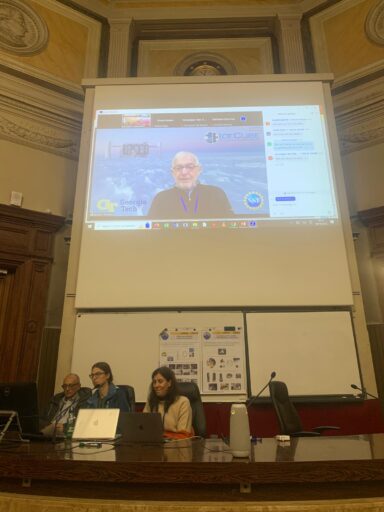
The ANTARES Collaboration is delighted to congratulate Professor Francis Halzen of the University of Wisconsin, winner of the 2026 Nobel Prize in Physics and one of the founders of neutrino astronomy, who for the past 35 years has led the development of the AMANDA and then IceCube neutrino telescopes, installed in the Antarctic ice.

Neutrino telescopes – of which ANTARES was the first to operate in the abyss of a sea – are vast three-dimensional arrays of photosensors deployed in a transparent medium, to observe the “Cherenkov light” signals that indicate the interaction of a high-energy neutrino with the matter surrounding the detector. This concept, first proposed in the 1960’s, began to be developed experimentally in the 1980s. After a first unsuccessful attempt to deploy an underwater detector off the coast of Hawaii (the DUMAND project), and in parallel with efforts in Russia to install a telescope in Lake Baikal, Francis Halzen proposed a new neutrino telescope project in the late 80s, this time using Antarctic ice as the detection medium.
On his initiative, the AMANDA prototype was successfully deployed at the South Pole in 1993-1994; then the 1 km3 IceCube neutrino telescope was completed in 2010, paving the way for the field of high-energy neutrino astronomy. In 2013, IceCube detected for the first time a diffuse high-energy neutrino signal from the cosmos. Since then, IceCube has also identified two distant galaxies as likely sources of neutrinos. For one of them – the TXS 0506 + 056 blazar, an active galaxy located more than 5 billion light-years from Earth and emitting a jet of matter pointing in our direction – the neutrino signal could be correlated in time and direction with light emissions seen by numerous telescopes, in radio waves, infrared, optical, X-rays and gamma rays. These observations constituted one of the very first examples of multi-messenger astronomy.
In parallel with the development of IceCube, efforts to build underwater neutrino telescopes continued in the Mediterranean Sea, in particular with the ANTARES prototype deployed off Toulon. Built between 2006 and 2008, ANTARES took data until 2022, demonstrating the long-term operability of an underwater detector and the excellent optical properties of seawater for neutrino detection. Although the results obtained by ANTARES alone did not reveal a cosmic neutrino signal, they were combined with those from IceCube in several jointly published studies, aimed at better characterizing and constraining the potential sources – galactic or extra-galactic – of these neutrinos.
The latest results obtained by ANTARES brings interesting constraints on the IceCube results.
Building on the success of ANTARES, developments are continuing in the Mediterranean Sea with KM3NeT, a network of next-generation detectors currently being installed off Toulon and Capo Passero (Sicily). The ARCA detector, comparable in size to IceCube, and the ORCA detector, smaller but more densely instrumented, will continue to scan the sky in search of cosmic neutrino sources and, who knows, the next supernova explosion that could take place in the vicinity of our galaxy. There’s no doubt that they will bring their share of discoveries in the years to come, contributing to the development of this new kind of astronomy.